€ 528RRP
Updated for the 2026/27 season
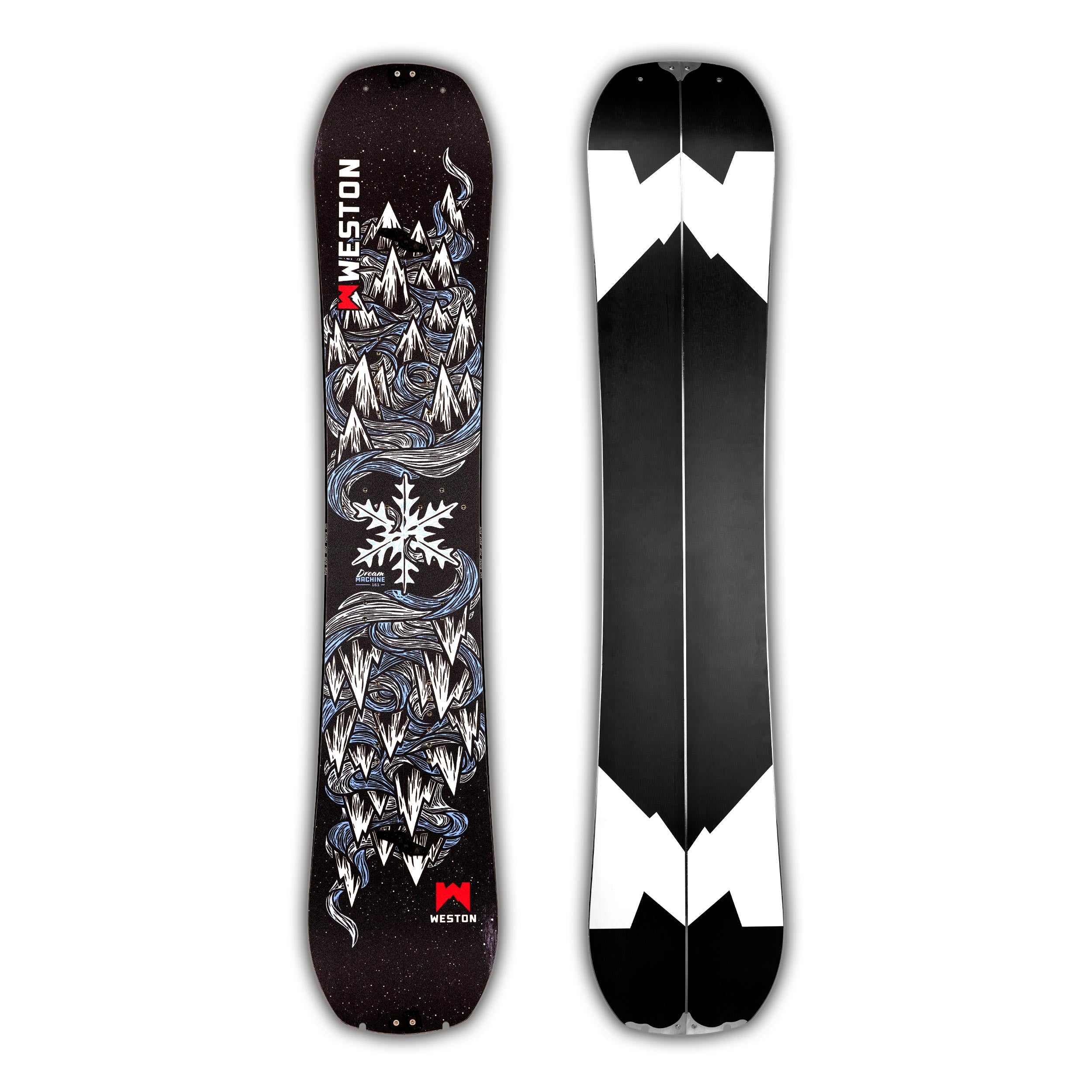
The Weston Dream Machine Split is the all-mountain workhorse of Weston’s 25/26 lineup — a directional twin splitboard designed for riders who want one board that handles everything from first tours to full-day big-mountain missions. Freedom Split Core, S-Weave Carbon, Spark R&D hardware. New this season. Currently sold out for 25/26 — check availability for 26/27.
Who is the Weston Dream Machine Split for?
The Dream Machine is built for intermediate riders entering backcountry and more experienced riders who want a versatile, approachable daily driver. The directional twin shape (unlike the tapered directional of the Backwoods and Gnarnia) means you can ride it in both directions, making it forgiving in variable conditions and easier to manage for riders still developing their backcountry technique.
It is Weston’s most affordable splitboard and the lightest board in their lineup at some sizes — ideal for long-distance tours where weight matters as much as performance. Flex around 5/10 (the softest in Weston’s split lineup).
Construction & Specs
- Shape: Directional Twin (not tapered — symmetric tip and tail width)
- Profile: All-Mountain — camber dominant with early rise nose
- Core: Freedom Split Core — Poplar + Paulownia + Bamboo (lightest in Weston lineup)
- Layup: Triax Fiberglass
- Carbon: S-Weave Tip to Tail Carbon
- Base: Sintered DuraSurf 4001 — holeless
- Sidewalls: UHMW (Ultra-High Molecular Weight Polyethylene)
- Topsheet: Castor Bean-based Rugged Nylon
- Touring hardware: Spark R&D Fixie Clips + Tip & Tail Clips
- Binding position: Shifted touring bracket — easier kick turns
- Skin attachment: Tip holes + tail notches
- Warranty: 4 years
Size & Weight Guide
| Size | Rider Weight (kg) | Rider Height (cm) | Effective Edge | Waist Width | Taper | Board Weight |
|---|---|---|---|---|---|---|
| 149 | 48–75 kg | 157–168 | 113.4 cm | 24.2 cm | 0 mm | 2770 g |
| 152 | 54–82 kg | 163–173 | 116.4 cm | 24.6 cm | 0 mm | 2850 g |
| 155 | 52–79 kg | 165–175 | 119.4 cm | 25.5 cm | 0 mm | 3100 g |
| 158 | 59–86 kg | 170–180 | 122 cm | 25.8 cm | 0 mm | ~3200 g |
| 158 Wide | 68–95 kg | — | 122 cm | 27+ cm | 0 mm | ~3350 g |
| 161 Wide | 75–102 kg | — | — | — | 0 mm | — |
| 164 Wide | 82–109 kg | — | — | — | 0 mm | — |
Wide versions for boot size US 12.5 or larger. 25/26 season sold out — check 26/27 availability.
Directional Twin: What It Means
Unlike every other board in Weston’s split lineup, the Dream Machine has 0 mm taper — the nose and tail are the same width. This is the defining feature of a twin shape. In practice, it means the board can be ridden equally well in both directions, which makes it more forgiving on variable terrain and easier to manage when you are not perfectly positioned. You pay for it in powder float (no taper means the tail does not sink naturally), but gain versatility and accessibility.
The 20 mm setback in the binding inserts compensates partially for the lack of taper — pushing your stance back gives some nose rise, but not as much as a tapered board achieves through shape alone.
Ride Feel
The softest board in Weston’s lineup (flex ~5/10), with the lightest core (Freedom Split Core with Paulownia). The S-Weave Carbon adds pop and snap throughout the board, which prevents the softer flex from feeling dead or washed out. At lower speeds and in variable conditions, the Dream Machine is forgiving and easy to steer. At higher speeds on steeper terrain, you will feel the flex limit — it is not a charging board.
In resort or sidecountry laps where you want to hit features and play, the twin shape earns its name. On long sustained descents in variable or firm snow, the Backwoods or Gnarnia will feel more planted and precise.
Uphill Performance
The Dream Machine is one of the lightest splitboards in Weston’s lineup: 2770 g for the 149, 2850 g for the 152. On long tours where every gram counts, that advantage is tangible. The Spark R&D Fixie Clips handle transitions — a different system from the Karakoram UltraClip used on the rest of Weston’s lineup, so check hardware compatibility if you already own Karakoram-specific accessories.
The holeless sintered base keeps glide fast on flat exit tracks. Use Weston Skin 2 for the 149/152/155, Skin 3 for 158, Skin 4 for 158W, Skin 6 for 161W, Skin 5 for 164W.
Verdict: Weston Dream Machine Split
The Dream Machine fills a gap in Weston’s lineup that the Backwoods and Gnarnia do not: an approachable, versatile, lightweight entry point for riders who are still building their backcountry skills, or experienced riders who want a lower-stakes daily driver. The soft flex, twin shape, and competitive price (the cheapest splitboard in Weston’s lineup) make it the logical starting point for the brand.
It sold out for 25/26 in its debut season — check back for 26/27 availability. If you need something in stock now, the Backwoods Split is the next step up in the lineup.
→ View all Weston splitboards · → Best splitboards for beginners
Frequently Asked Questions
Is the Dream Machine Split good for beginners?
Yes — it is Weston’s most beginner-friendly splitboard. The soft flex (5/10), forgiving twin shape, and lighter weight make it easier to learn on than the stiffer, more demanding Backwoods or Gnarnia. It is also Weston’s cheapest splitboard, making it a lower-risk entry point to the lineup.
What hardware does the Dream Machine Split use?
Spark R&D Fixie Clips and Tip & Tail Clips — different from the Karakoram UltraClip used on the Backwoods, Gnarnia, Eclipse, and Japow. This matters if you want to share hardware between boards or already own Karakoram-specific gear.
How does the Dream Machine compare to the Backwoods Split?
The Dream Machine is softer (flex 5 vs 7), lighter, cheaper, and uses a twin shape with no taper. The Backwoods is a tapered directional with more float in powder, more edge hold on steeps, and a higher performance ceiling. For progressing riders and all-mountain versatility: Dream Machine. For riders who already charge hard: Backwoods.
User Reviews
There are no reviews yet. Be the first one to write one.