Yes, there’s a budget option. No, “cheapest” is not the same as “good enough.” Here’s the entry-level pick, and an honest, unfiltered look at what you give up when you save money on the one device meant to save your life.
The most important line in this whole article: training beats gear, always.
A cheap beacon in practised hands beats an expensive one in untrained hands — but that’s an argument for training, not for buying the cheapest thing on the shelf. Whatever you buy, take an avalanche course, drill your companion rescue until it’s automatic, and practise before you ever leave the piste. The device is the floor of your safety, not the ceiling. Your knowledge is the ceiling.
The budget pick: Arva EVO4
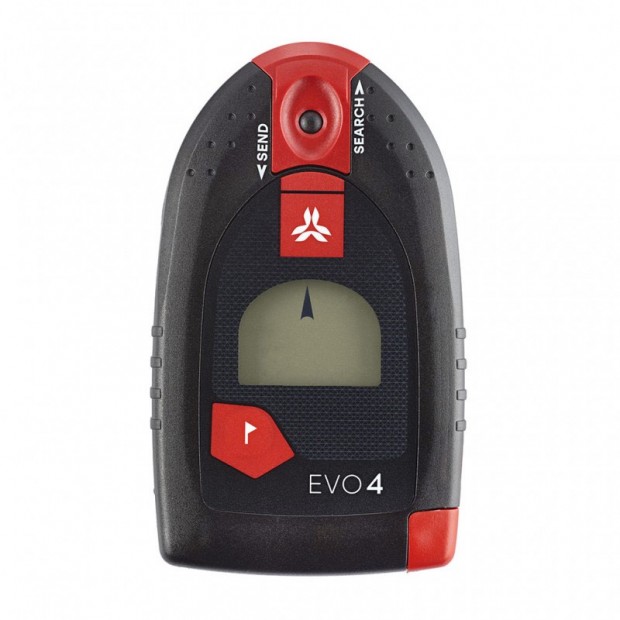
The Arva EVO4 (€189.90) is the most affordable modern transceiver we’d even consider. To its credit, it covers the non-negotiables: three antennas, the 457 kHz standard, a marking function for multiple burials, and motion-triggered basics. For a tight budget, it’s a real beacon — not a toy.
But “the cheapest one worth buying” comes with trade-offs you need to see clearly before you decide.
What you actually give up
This is the part the price tag doesn’t tell you:
- Narrower search strip (40 m). That’s roughly half the reach of a flagship’s 80 m. In a real search you make more passes over the debris, and every extra pass costs time a buried partner doesn’t have.
- Heavier and bulkier (255 g, 4× AAA). The budget model is the heaviest here, while lighter beacons cost more. You feel it on every tour.
- Slower, simpler multiple-burial handling. Entry beacons are more prone to getting confused when signals overlap — exactly the high-stress scenario where you least want to be fighting your device.
- No Bluetooth, no app, no firmware updates. You can’t refine settings or keep the software current. What you buy is what you’re stuck with.
- Basic display and feedback. Less on-screen guidance through the fine search — fine for a trained user, punishing for a panicked one.
None of these make the EVO4 unsafe. They make it slower and less forgiving — and in avalanche rescue, slower is the entire problem.
Do the maths on what you’re saving
The gap between the budget EVO4 and a mid-range all-rounder like the Mammut Barryvox 2 is around €190. Spread across the life of a beacon — easily 8–10 seasons — that’s roughly €20 a year. For that, you double your search strip, drop 75 g, get faster multiple-burial handling, and gain updatable software.
Put bluntly: this is the last place in your kit to chase a bargain. People will spend €600 on a board and €500 on boots, then flinch at €380 for the device that finds them under the snow. That’s backwards.
- Buy the EVO4 if budget is a hard wall and the honest alternative is skiing the backcountry with no beacon — in which case a real transceiver you can afford beats nothing, every time.
- Skip it if you can stretch to the mid-range. The Barryvox 2, Ortovox Diract, or Arva EVO5+ are worth every extra euro.
The bottom line
Budget gear is a valid choice when it’s the difference between having a beacon and not. It is not a smart place to economise if you can afford better — because the thing you’re trading away is search time, and search time is survival time.
But whichever you choose, remember the hierarchy: skills first, device second. The best money you’ll ever spend on avalanche safety isn’t a beacon at all — it’s the course, and the hours in the beacon park, done before you head into the backcountry. Buy the best transceiver you can, then go earn it with practice.
Written by Splitboard-Specialist — based on specs, no test rides, no sponsoring. Beacon safety is never a substitute for formal avalanche education.
Leave a Reply