
For the experienced backcountry crowd — patrollers, guides, and riders who run multiple-burial drills for fun. If you’re new to transceivers, start with our allrounder guide instead; this one gets technical.
Read this first — the device is the smallest part of the equation.
No beacon on this page will save anyone if you can’t run a clean search under stress. The gear buys you margins; your training buys you the rescue. Book the avalanche course, drill your companion rescue until the coarse-to-fine transition is muscle memory, and practise before you drop into the backcountry — not on the day it goes wrong. Every second you shave off in the beacon park is a second a buried partner gets back.
What actually separates a flagship from a mid-range beacon
All modern transceivers share the basics: three antennas, the global 457 kHz standard, digital processing, and a marking (flagging) function. At the top of the range you’re paying for performance under the ugly scenarios — deep burials, multiple signals, overlapping pulses, interference.
The specs that matter to an expert:
- Circular receiving range & search strip width. A wider strip means fewer pasyes over the debris and a faster first signal. The flagship field runs 70–80 m strips versus 40–50 m on entry models.
- Signal separation & processing. How cleanly the device isolates overlapping transmitters in a multiple burial — and how it handles spike/false-maxima behaviour on deep signals.
- Marking robustness. Can you flag a resolved victim and trust it stays flagged when a masked signal reappears?
- Motion-sensor auto-revert. Reverts you from search back to transmit after a set stillness window — your protection against a secondary slide.
- Serviceability. Bluetooth firmware updates, diagnostics, and a display you can read with goggles down and mittens on.
Pieps PRO IPS — the benchmark for range and signal integrity

The Pieps PRO IPS (€479.95) posts the widest search strip in this comparison at 80 m, and backs it with two acronyms worth knowing. IPS (Interference Protection System) suppresses disturbance in transmit mode, and DASP (Dual Antenna Signal Processing) stabilises the signal during the coarse search. Runtime is class-leading: 600 h alkaline, 800 h lithium. Three AAA, 212 g.
For a lead searcher who wants maximum reach and a no-nonsense interface, this is the tool. The IPS line is a clean generation — judge it on what it is now.
- Buy it if you prioritise raw range, signal stability, and long runtime for guiding or patrol work.
- Skip it if you want on-screen hand-holding through the fine search — the PRO IPS trusts you to know what you’re doing.
Mammut Barryvox S2 — the best-guided search on the market
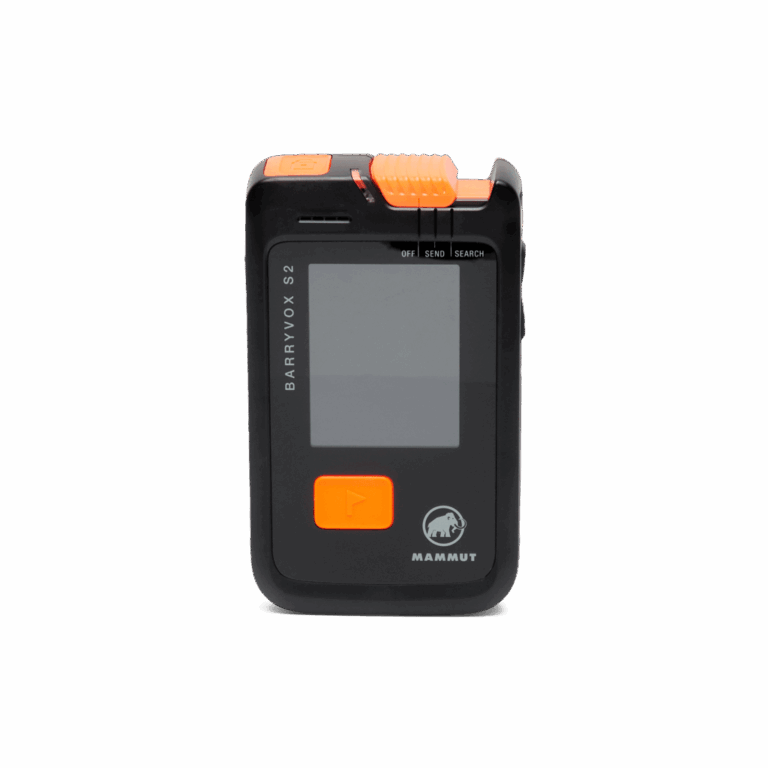
The Mammut Barryvox S2 (€480) pairs a 70 m range and strip with Mammut’s animated Smart Search guidance, which visually walks you through the micro-search — genuinely useful when the adrenaline spikes and fine motor control drops. At 180 g it’s also the lightest flagship here. Analog audio and pro settings sit behind the menus for advanced users; the pro-favourite Barryvox S (€490, previous generation) is still sold for those who prefer the older interface.
- Buy it if you want elite performance plus the most reassuring guided search when it counts.
- Skip it if you never look at the screen and want pure analog feel — the older Barryvox S or a Tracker suits you better.
Arva NEO BT PRO — digital reach with an analog escape hatch
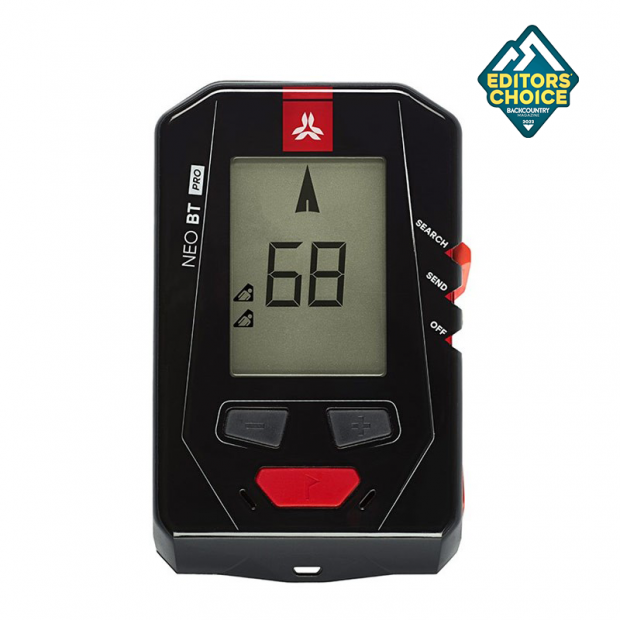
The Arva NEO BT PRO (€374.90) is the connoisseur’s toolbox: 80 m strip, a crisp OLED display, a full Bluetooth app for updates and training, and — rare now — a true analog mode that extends usable range on deep or complex burials. That analog fallback is why a lot of professionals keep an Arva in the kit.
- Buy it if you actively use analog searching and want configurable, updatable pro features.
- Skip it if you want plug-and-play — and note the mandatory safety check / recall (Jan 2025): verify any unit (especially second-hand) has been serviced before you rely on it.
Flagship comparison
| Model | Range | Search strip | Weight | Analog mode | Price (RRP) | Edge |
|---|---|---|---|---|---|---|
| Pieps PRO IPS | 70 m | 80 m | 212 g | No | € 479.95 | Range + runtime |
| Mammut Barryvox S2 | 70 m | 70 m | 180 g | Yes (audio) | € 480 | Guided fine search |
| Arva NEO BT PRO | 50 m | 80 m | 210 g | Yes (full) | € 374.90 | Analog + digital |
The expert’s honest verdict
At this level the differences are real but marginal — and every one of them is dwarfed by the searcher holding the device. A guide with a five-year-old beacon and current skills will out-search a novice with the newest flagship every single time. Buy the tool that matches how you search, then earn the right to carry it: run the drills, keep the firmware current, and rehearse your companion rescue before the season starts, not during your first real burial.
Written by Splitboard-Specialist — based on specs, no test rides, no sponsoring. Beacon safety is never a substitute for formal avalanche education.
Leave a Reply